
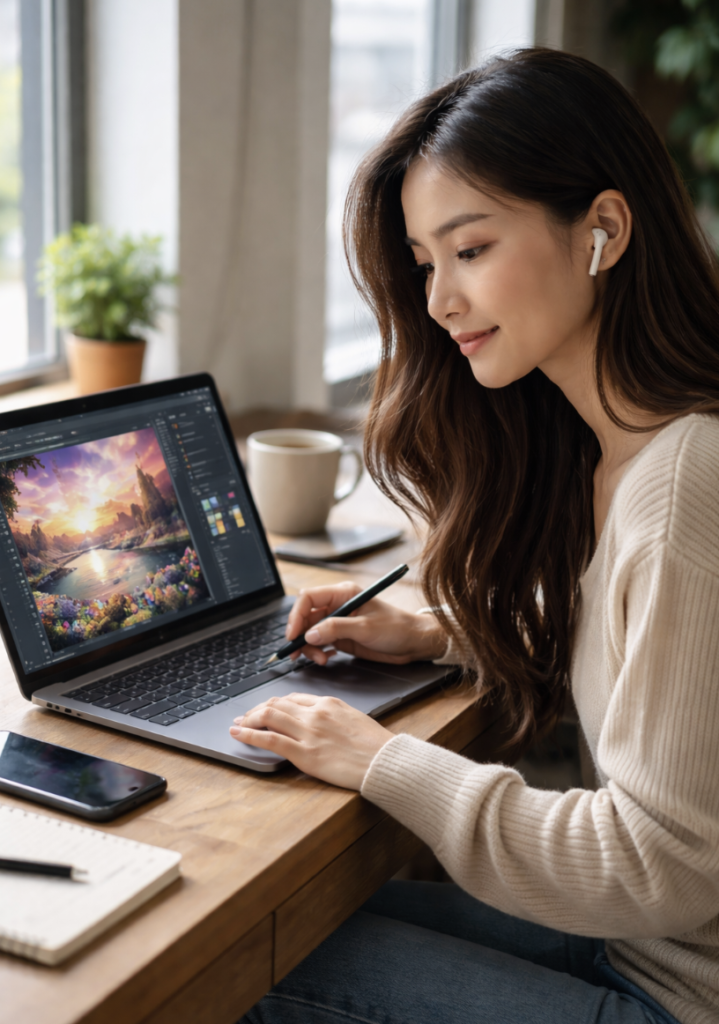
There’s always been a quiet tension in creative work: how much of the final result is you, and how much is the tool?
With Adobe Photoshop 2026, that question isn’t just philosophical anymore—it’s unavoidable.
Because for the first time, using Photoshop doesn’t feel like operating software.
It feels like skipping steps.
Not long ago, creating something impressive in Photoshop required layers of skill—masking, blending, lighting, composition, color grading. You didn’t just make an image, you engineered it.
Now?
You describe what you want, and it gets alarmingly close on the first try.
Want to extend a background? Done.
Fix lighting across an entire scene? Done.
Remove distractions, add elements, change mood, alter time of day?
Done, done, done.
What used to take hours now takes minutes. What took minutes now takes seconds.
And what used to require experience… now just requires taste.
The biggest shift isn’t speed. It’s intent.
Photoshop 2026 doesn’t just execute commands—it interprets them.
Instead of thinking in tools (“I need to use clone stamp, then curves, then masks”), you think in outcomes:
And it understands.
Not perfectly—but close enough that the gap between idea and result is smaller than it’s ever been.
That’s where the “cheating” feeling comes from.
You’re no longer wrestling with the software.
You’re collaborating with it.
Ironically, as Photoshop gets easier, good design doesn’t.
Because when everyone has access to the same powerful tools, technical skill stops being the differentiator.
Taste does.
Two people can give the same prompt and get wildly different results—based on subtle decisions:
Photoshop 2026 doesn’t replace creativity. It exposes it.
If anything, it makes bad taste more obvious—and good taste more valuable.
There’s a downside to all this speed.
When creating something becomes effortless, it’s easier to settle.
You stop exploring.
You accept “good enough.”
You move on too quickly.
Before, the process forced you to think. Now, it’s optional.
And that’s dangerous.
Because the best work rarely comes from the first result—it comes from iteration, friction, and refinement.
Photoshop 2026 removes a lot of that friction.
Which means you have to choose to slow down.
Is it cheating if everyone can do it?
That depends on what you value.
If creativity is about effort, then yes—this feels like cutting corners.
If it’s about outcomes, ideas, and communication, then it’s just evolution.
Every major leap in creative tools has sparked the same debate:
And now: AI-assisted creation vs manual work
The pattern is always the same.
At first, it feels like cheating.
Then it becomes the standard.
Photoshop 2026 doesn’t just change how we edit images.
It changes who gets to create them.
People who were locked out by complexity can now participate.
Professionals can move faster than ever.
And the ceiling for what’s possible keeps rising.
But the rules of good work haven’t changed.
Clarity. Composition. Story. Taste.
Those still matter.
Maybe more than ever.
It feels like it.
But only if you think the hard part was using the software.
It never was.
The hard part is knowing what’s worth making in the first place.
And Photoshop 2026?
It just removed your excuses.