
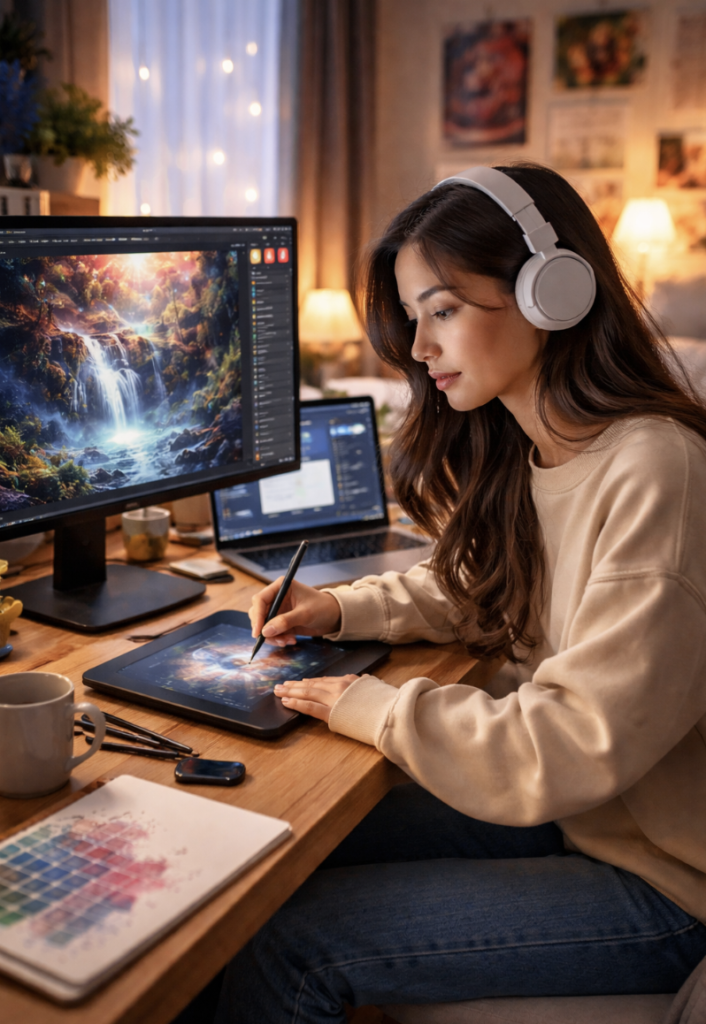
The art industry in 2026 is in the middle of a major shift. What began as experimental AI-generated images has quickly evolved into a powerful force that’s changing how artists create, refine, and share their work.
For artists working in Photoshop, AI isn’t replacing creativity—it’s reshaping the artistic process itself.
The real question now is no longer “Should I use AI?” but “How do I use it without losing my artistic identity?”
AI tools have advanced far beyond basic filters. Artists can now generate concepts from text prompts, expand compositions instantly, and experiment with styles in seconds.
What once took hours—complex compositing, detailed retouching, or ideation—can now happen almost instantly.
But there’s a catch.
As more artists rely on similar tools, a recognizable “AI style” is starting to dominate—technically impressive, but often lacking individuality. This is where true artists stand apart. The ability to refine, reinterpret, and inject personality into AI-assisted work is becoming the defining skill.
Photoshop in 2026 has evolved into more than just an editing tool—it’s where artistic decisions happen.
AI can generate a starting point, but Photoshop is where artists:
The distinction is clear:
With AI lowering the barrier to entry, high-quality visuals are everywhere. But quality alone isn’t enough anymore—originality is what stands out.
Audiences and clients are becoming more aware of generic AI art. They’re looking for:
Artists who develop a recognizable visual identity—through color, composition, and technique—will continue to stand above the noise.
AI has also introduced new challenges around ownership and authorship.
In 2026, ongoing discussions include:
For artists using Photoshop, this means being more thoughtful about how AI is integrated into professional work. Transparency and originality are becoming increasingly important.
Being an artist in 2026 goes beyond technical ability. It’s about combining traditional artistic instincts with new tools.
Key skills now include:
AI can generate endless variations—but the artist’s eye determines what is worth keeping.
There’s a lot of discussion about AI replacing artists, but that oversimplifies the reality.
AI increases accessibility, which means more competition—but it also opens new creative possibilities. Artists can work faster, experiment more freely, and explore ideas that were once too time-consuming.
The artists who thrive aren’t the ones who avoid AI or rely on it completely—they’re the ones who use it strategically while maintaining their unique voice.
AI isn’t the end of art—it’s a transformation of the creative process.
For artists using Photoshop, the advantage lies in combining technology with human creativity. Anyone can generate an image, but not everyone can turn it into something meaningful.
In 2026, the artists who succeed will be those who embrace AI as a tool—while ensuring their work still feels distinctly human.
Be Sure To Subscribe to this Youtube channel to learn more Photoshop Tips & Tricks.